

A clean collagen powder has one ingredient: hydrolyzed collagen peptides. No fillers, binders, anti-caking agents, sweeteners, flavorings, colors, or preservatives. It states its source, it is third-party tested for heavy metals, and the label tells you exactly how many grams of collagen are in a serving. If an ingredient list runs longer than a line, you are paying for things that are not collagen.
Louis's takeaways:
“Clean” has no legal definition on a supplement label, so it’s worth knowing what to look for yourself. Turn the tub around and read the ingredient list rather than relying on the front label. Ideally, collagen should be the only ingredient. Watch for three specific things: proprietary blends that make it difficult to tell how much collagen you’re actually getting; anti-caking and flow agents added to address mixing or flow issues; and flavorings that may contain added sugars or sweeteners. Third-party heavy-metal testing is separate from the ingredient list, but it matters just as much.
Table of Contents:
The word “clean” has no legal or regulated definition on a supplement label. Brands can use the term without meeting any specific standard, so the front of the tub doesn't tell you much about what's actually inside.
Instead, look at the product itself. A collagen powder that deserves to be considered “clean” should generally have:
- A short, transparent ingredient list: Ideally, collagen should be the only ingredient, with no unnecessary additives.
- A clearly identified source: Terms like grass-fed or pasture-raised bovine provide specific information about the collagen source. “Premium collagen” doesn't tell you where it comes from.
- Third-party testing: Look for independent testing for contaminants, such as heavy metals, and check whether the test results are actually available.
- A clearly stated dose: The label should tell you exactly how many grams of collagen you get per serving.
The One Ingredient Standard
Collagen is unusual among supplements because it genuinely does not need anything added to work. It is a protein. Hydrolyze it into peptides, dry it, and it dissolves in liquid, carries no flavor of its own, and delivers what it is supposed to deliver.
So the standard we hold a collagen powder to is simple. The ingredient list should read “hydrolyzed collagen peptides” and stop there.
That is what separates collagen from a greens powder or a pre-workout formula, where a long ingredient list is the whole point. With collagen, every additional ingredient is either solving a problem the manufacturer created, replacing collagen with something cheaper, or making it taste like vanilla.
Some additions are defensible. Vitamin C paired with collagen makes sense, since your body needs vitamin C to synthesize collagen on its own. What is not defensible is a fourteen item list you have to research before buying it.
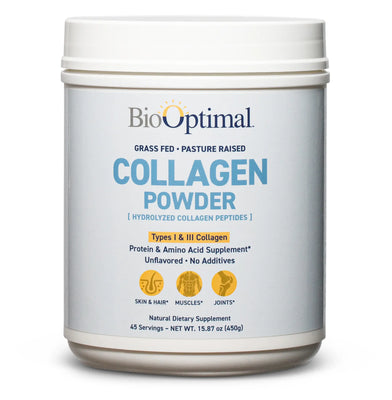
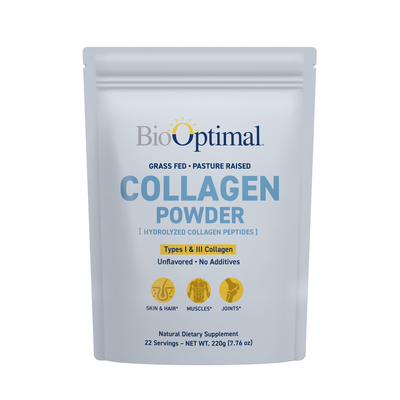
Our Collagen Powder is a single ingredient, double hydrolyzed Type I and III collagen peptides from grass-fed, pasture-raised bovine, free from hormones and antibiotics, and non-GMO. There are no fillers, binders, additives, or preservatives, and no gluten, wheat, dairy, soy, fish, peanuts, or yeast. One 10 gram scoop delivers 45 servings per tub, with zero sugar.
What Gets Added to Collagen Powder and Why
Here is what you are actually looking for on a label, why it is there, and whether it should concern you.
What you might see |
Why it is there |
Should you care |
Silicon dioxide, magnesium stearate, tricalcium phosphate |
Anti-caking and flow agents that stop the powder clumping in the tub and help it run through filling machinery |
These are generally recognized as safe, but they are a clue. A well hydrolyzed powder does not need help staying loose. If flow agents are doing that work, ask why. |
Maltodextrin, dextrose, rice flour, inulin |
Bulking agents and fillers that add volume cheaply |
Yes, care about this one. Every gram of filler is a gram that is not collagen, and the scoop size hides it from you. |
Natural flavors, cocoa, vanilla |
Taste |
Only if you wanted flavor. Flavoring usually arrives with sweeteners, and it means you cannot use the powder in savory cooking. |
Stevia, monk fruit, sucralose, sugar |
Sweetness |
Yes if you are avoiding sweeteners. Unflavored collagen needs none of it, since it has no taste to mask in the first place. |
Proprietary blend |
Lets a brand list ingredients without disclosing amounts |
The biggest red flag on this list. If a label will not say how many grams of collagen sit in a serving, assume the number is not flattering. |
Hyaluronic acid, biotin, vitamin C |
Added actives |
Not a problem in principle, and vitamin C genuinely helps collagen synthesis. Just check you are not paying a premium for trace amounts. |
Preservatives |
Shelf stability |
A dry powder stored properly does not need them. |
For storage tips that protect potency without needing preservatives, see our guide on how long collagen powder lasts.
The pattern worth noticing is that most additives in collagen powder exist to fix mixability or add flavor, and both are solved better by the collagen itself. Double hydrolyzation handles dissolving, and going unflavored handles taste.
If clumping has been your issue, our guide on how to mix collagen powder without clumping covers the technique, and technique fixes most of it.
How to Read a Collagen Label in 60 Seconds
Run through five checks, in order, on the back of the tub rather than the front.
- Count the ingredients. One is ideal. Two or three with a clear reason is fine. Ten means look elsewhere.
- Find the grams of collagen per serving. It should be stated plainly. If you only see a scoop size next to a proprietary blend, you cannot know what you are buying.
- Check the source. Bovine or marine, and how the animals were raised. Specificity is the signal, and vagueness is the tell.
- Look for the word “hydrolyzed” or “peptides.” Un-hydrolyzed collagen absorbs poorly and does not dissolve the way it should.
- Look for third-party testing, either on the label or on the brand's site as a Certificate of Analysis.
If a product passes all five checks, the front of the tub barely matters anymore.
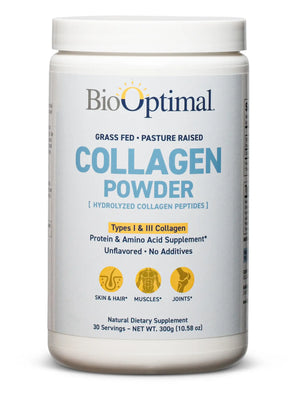
Compare formats and sizes across our collagen collection, or start with the 20-serving collagen powder at $16.99 if you want to check the label and the mixability yourself before committing to a larger size.
Clean Does Not Automatically Mean Tested
This is the distinction most collagen content on the topic misses, and it matters.
A short ingredient list tells you what a manufacturer added. It tells you nothing about what came in with the raw material. Collagen comes from animal hide and bone, and cattle can accumulate lead, arsenic, mercury, and cadmium from soil, water, and feed over a lifetime. A single ingredient powder can still carry contaminants, because contaminants are not an ingredient a brand chooses to add.
So the ingredient list and the lab report are two separate checks, and a product needs to pass both. Ask for the Certificate of Analysis, and confirm it shows tested values rather than just the word “pass.”
Our full breakdown of what independent testing has found across popular collagen brands, and how to read a COA line by line, is in our heavy metal testing guide.
Every batch of our collagen is third-party tested for heavy metals and other contaminants, and made in a GMP-certified facility. We are US-based and BBB-accredited, with our facility located in Smithtown, New York.
What Our Customers Say About Clean Ingredients
This is the most common reason people tell us they switched.
"I appreciate so much that this is allergen free, and third party tested! Great product, I will continue to buy!"
Tara Barger, verified buyer, BioOptimal Multi-Collagen Capsules
"Just about every supplement on the market was loaded with salt and a whole bunch of other additives that I did not want or need. Finally I came across this one. It was exactly what I was looking for."
Annette Gara, verified buyer
"It is next to impossible to find a simple, unflavored, clean, natural supplement of collagen powder! After hours of searching, I am grateful to have found this supplement!"
Annette Gara, verified buyer
"I switched to BioOptimal so that I could have a grass fed clean product free of fillers and gluten."
Sharon Morrison, verified buyer
"This was recommended as a clean product. Both my husband and I use it."
Happy, verified purchase, Amazon
The word that keeps coming up is “simple.” That is worth holding any collagen brand to as a standard, ours included.
Frequently Asked Questions
1. What is a clean collagen powder?
A collagen powder with one ingredient, hydrolyzed collagen peptides, and nothing else added. No fillers, binders, anti-caking agents, sweeteners, flavorings, colors, or preservatives are present. It also names its source specifically, states the grams of collagen per serving, and is third-party tested for heavy metals. “Clean” is not a regulated term, so the ingredient list on the back is the only reliable check.
2. What is the best clean collagen powder?
Look for four things rather than a brand name. A one ingredient list, a named source such as grass-fed pasture-raised bovine, a stated grams per serving figure, and published third-party heavy metal testing. Any product meeting all four qualifies. Anything with a proprietary blend, added sweeteners, or an unnamed source does not, no matter what the front of the tub says.
3. Does collagen powder have fillers?
Many do. Common fillers and flow agents include maltodextrin, dextrose, rice flour, silicon dioxide, and magnesium stearate. They add bulk or help the powder run through machinery, and every gram of them is a gram that is not collagen. A single-ingredient powder has none. Check the ingredient list rather than the marketing.
4. Is unflavored collagen cleaner than flavored?
Usually, yes. Flavoring rarely arrives alone. It typically brings sweeteners, and sometimes colors and thickeners, which is how a two-ingredient product becomes a ten-ingredient one. Unflavored collagen needs none of it, because hydrolyzed collagen has no taste to mask.
5. What are anti-caking agents in collagen powder?
Ingredients such as silicon dioxide or tricalcium phosphate are added to stop powder clumping in the container and to help it flow during manufacturing. They are generally regarded as safe. They are also a signal worth reading, because a properly hydrolyzed collagen powder does not need help staying loose or dissolving.
6. Does a clean ingredient list mean the collagen is free of heavy metals?
No, and this is the most common misunderstanding. The ingredient list shows what was added. Heavy metals are not added; they come in with the raw material from the animal's environment. A single-ingredient powder can still carry them. You need both a short ingredient list and a third-party Certificate of Analysis.
7. Is a proprietary blend a problem on a collagen label?
It is the biggest red flag on a collagen label. A proprietary blend lets a brand list ingredients without disclosing how much of each is present, which means you cannot know how many grams of collagen you are getting per serving. Choose a product that states the number.
Get a Collagen Powder You Can Read in One Line
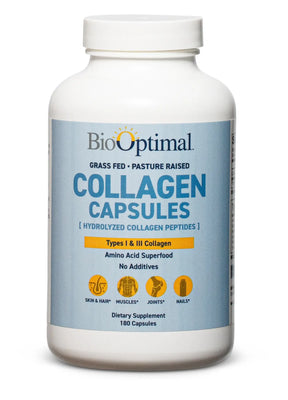
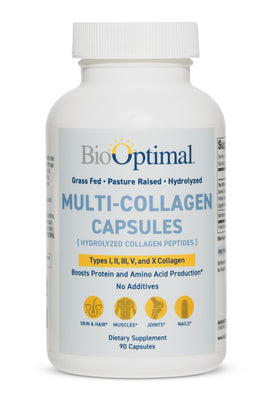
If you want a collagen powder you can read in one line, shop our 45-serving collagen powder, one ingredient, grass-fed and pasture-raised, third-party tested for heavy metals, unflavored, and zero sugar. Prefer capsules? Try our collagen capsules, or our multi-collagen capsules for five collagen types. Browse the full collagen collection to compare every option side by side.
Still deciding between formats? Read our comparison of collagen powder vs pills. Over 50? Read our guide to the best collagen for women over 50. You can also read more about our sourcing and testing standards on our story page.